Pleven is a city with an ancient history, but it gained worldwide recognition during the Russo-Turkish War of 1877–1878. It was here that the successful outcome of the war was decided – a war that led to the restoration of the Bulgarian state after five centuries of Ottoman rule.
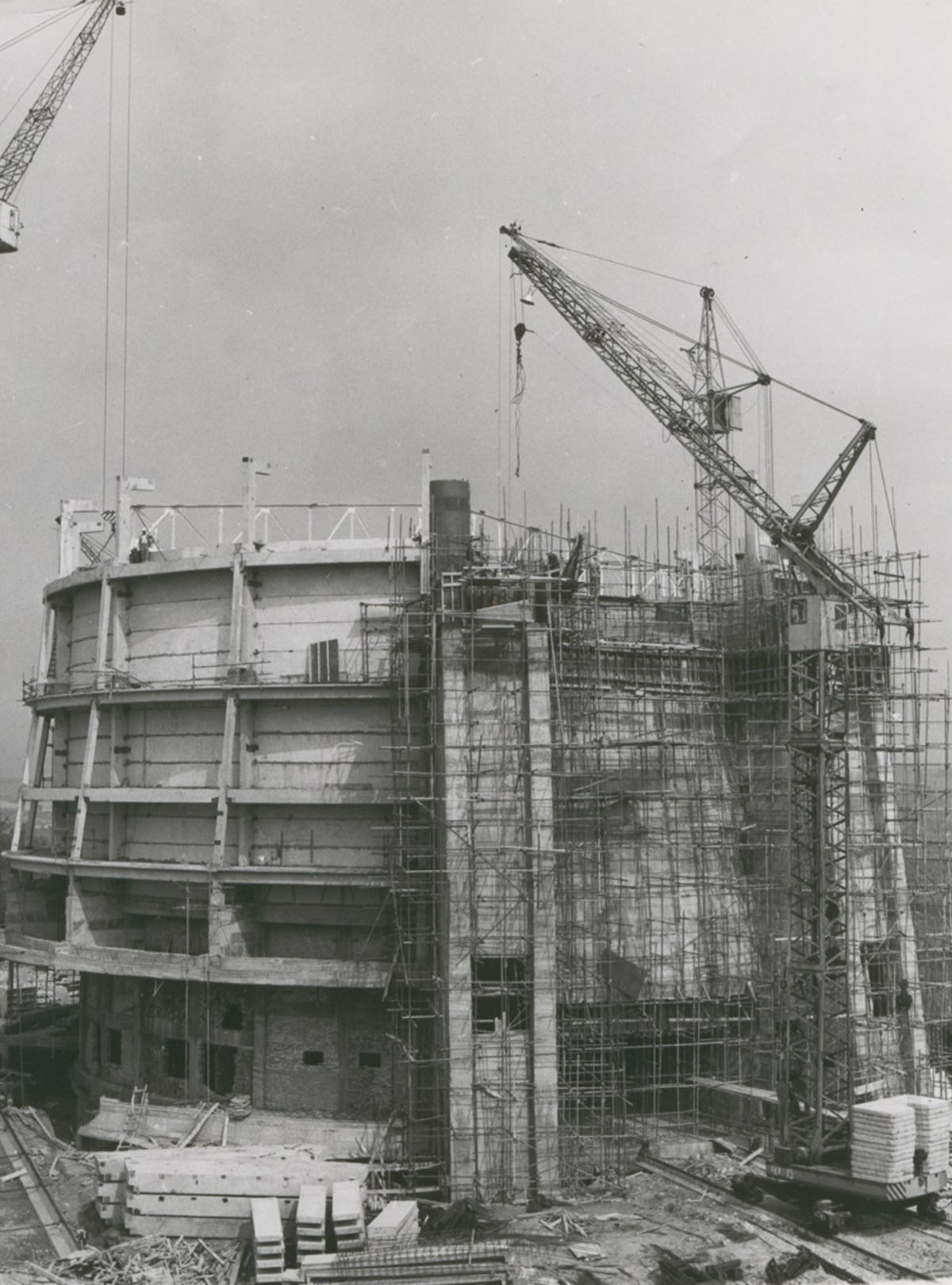
The panorama was created to mark the 100th anniversary of the liberation of the city on December 10, 1877. It is located on the battlefield itself, between two Ottoman fortifications that were attacked by the detachment of General Mikhail Skobelev during the Third Military Assault on Pleven on September 11 and 12, 1877.
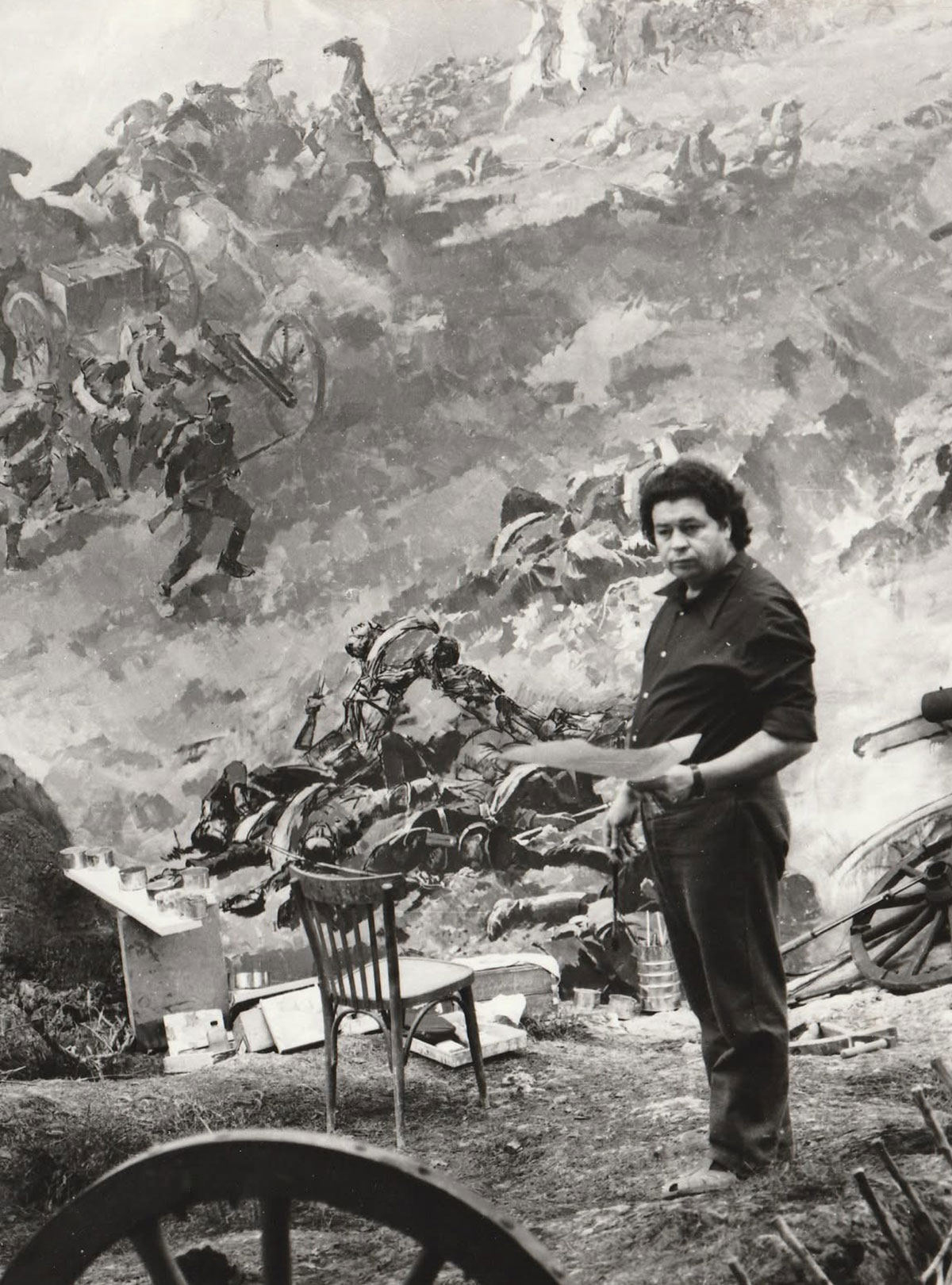
The panoramic complex was built in 10 months and 20 days and opened its doors on December 10, 1977. The project was designed by architects Ivo Petrov and Plamena Tsacheva. The artistic work was carried out by a team of 13 artists – 11 from Russia and 2 from Pleven – led by Nikolai Ovechkin from the Grekov Military Art Studio in Moscow.
Please proceed upstairs to the first hall.
Artist: N. Ovechkin
The first painting takes us back to the end of the 14th century, when the Bulgarian lands fell under Ottoman rule. The Bulgarian state was destroyed. The population was subjected to exploitation, forced assimilation, and displacement. The Ottoman authorities imposed numerous taxes, the harshest of which was the blood tax, known as devshirme. Periodically, boys were taken from Christian families, trained severely, forced to convert to Islam, and enrolled in the Janissary Corps – the elite army of the Ottoman Empire.
Artist: N. Ovechkin
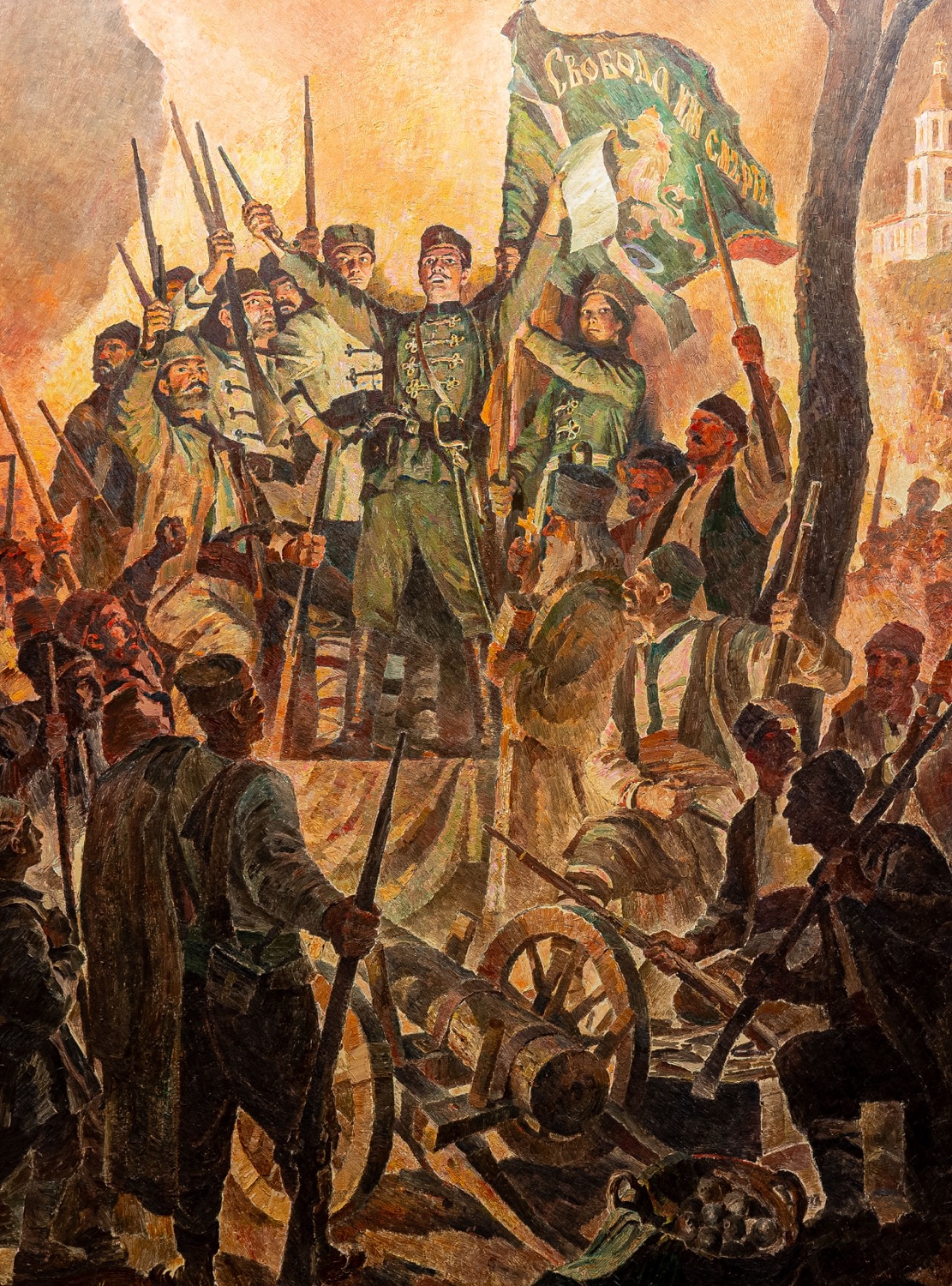
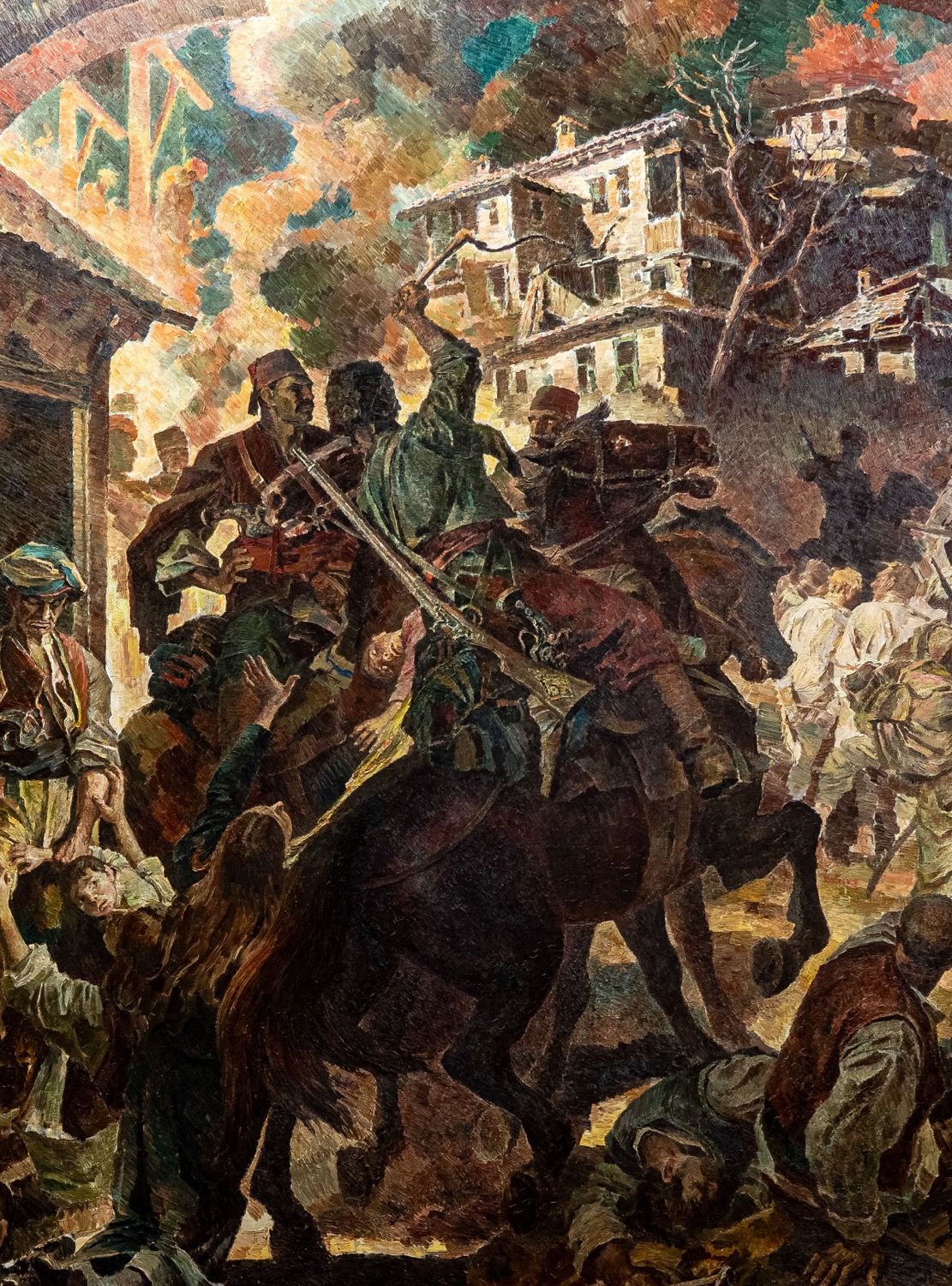
Driven by the desire for freedom, the Bulgarians organized many revolts and uprisings. The largest of these was the April Uprising of 1876. In the foreground of the painting are depicted two national heroes. Georgi Benkovski proclaims the uprising in the town of Panagyurishte, while the teacher Rayna Popgeorgieva sews the flag and embroiders the symbol of Bulgarian statehood – the golden lion – and the motto “Freedom or Death.”
Against the rebels stood a well trained and modernly equipped Ottoman army. The uprising was brutally suppressed. Around 30,000 innocent Bulgarians were killed. Hundreds of settlements were burned and destroyed.
Artists: N. Ovechkin and V. Lemeshev
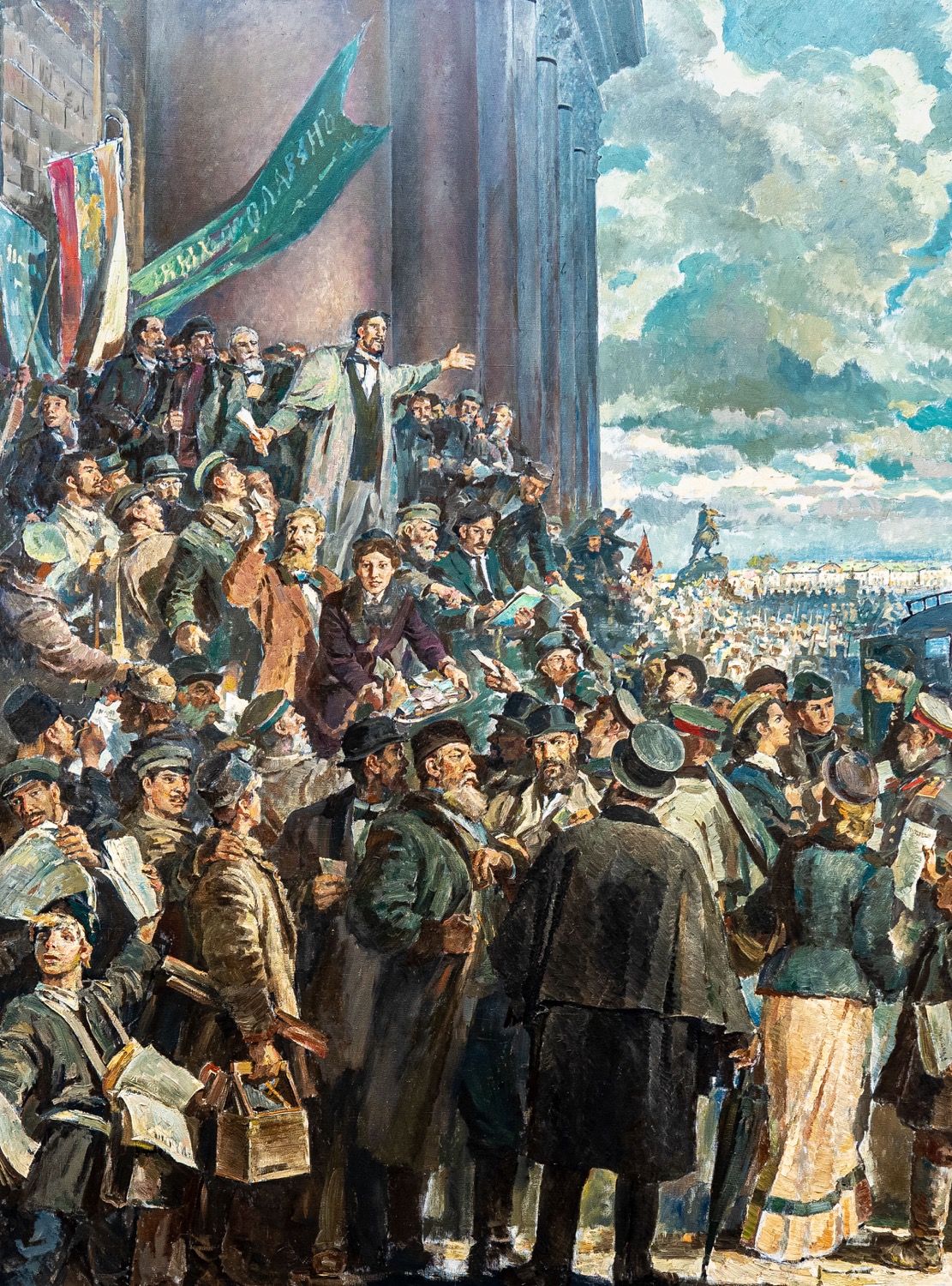
The brutal suppression of the April Uprising sparked a wave of protests. The Bulgarian cause drew the attention of Europe and the wider world. In the Russian Empire, rallies were organized, including the one depicted here in Saint Petersburg. Money, clothes, and food were collected, and there were even calls to help through armed forces.
Artists: N. Ovechkin and I. Kabanov
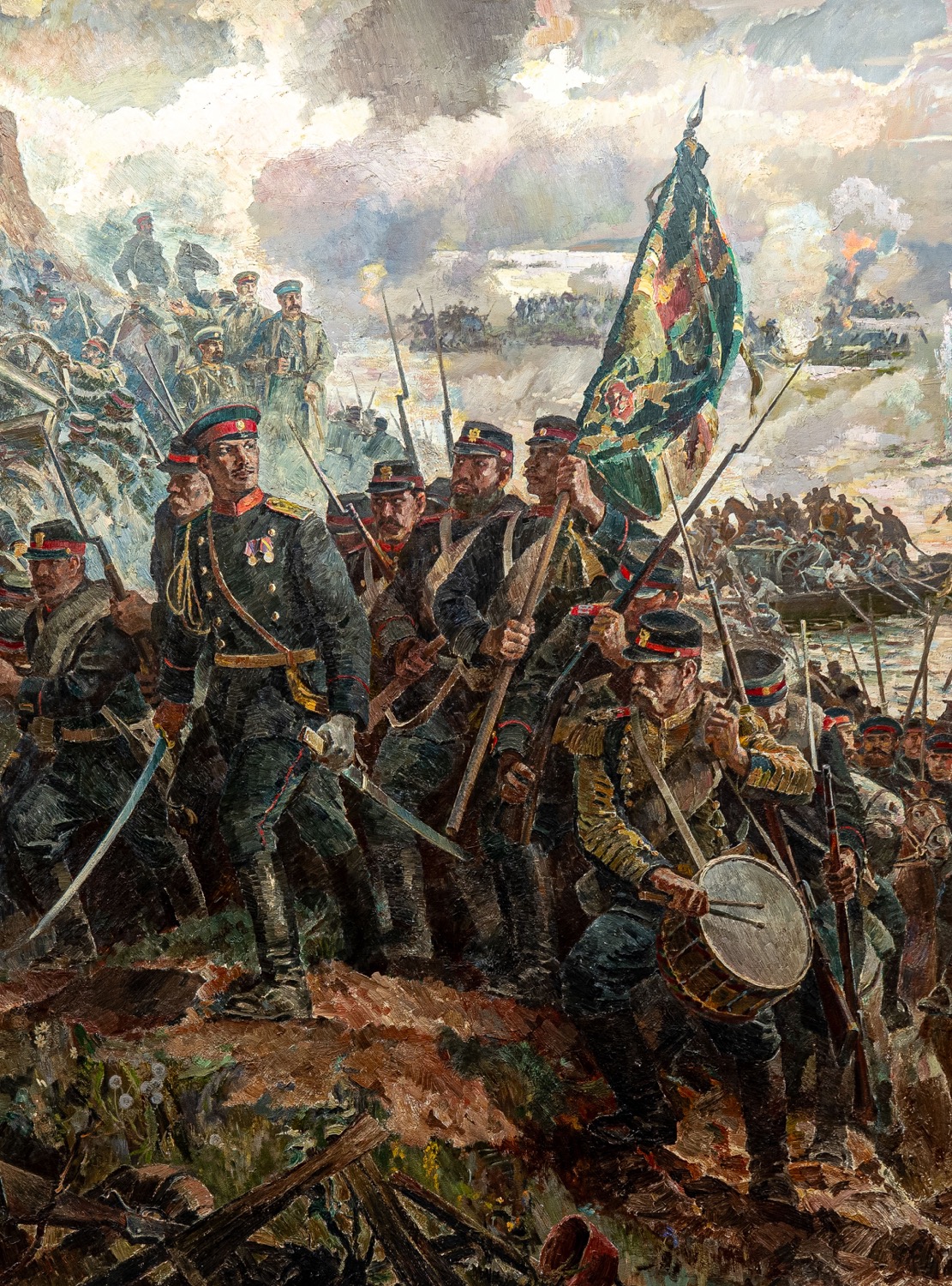
After all diplomatic efforts to resolve the conflict in the Balkans failed, on April 24, 1877, Russian Emperor Alexander II declared war on the Ottoman Empire. In May, Romania joined Russia, and Russian troops advanced toward the Bulgarian lands through Romanian territory.
On the night of June 26–27, 1877, General Dragomirov’s division crossed the Danube near the town of Svishtov and liberated it. This brilliantly executed operation marked the beginning of the Russian army’s large-scale offensive in the Balkans.
Artist: N. Ovechkin
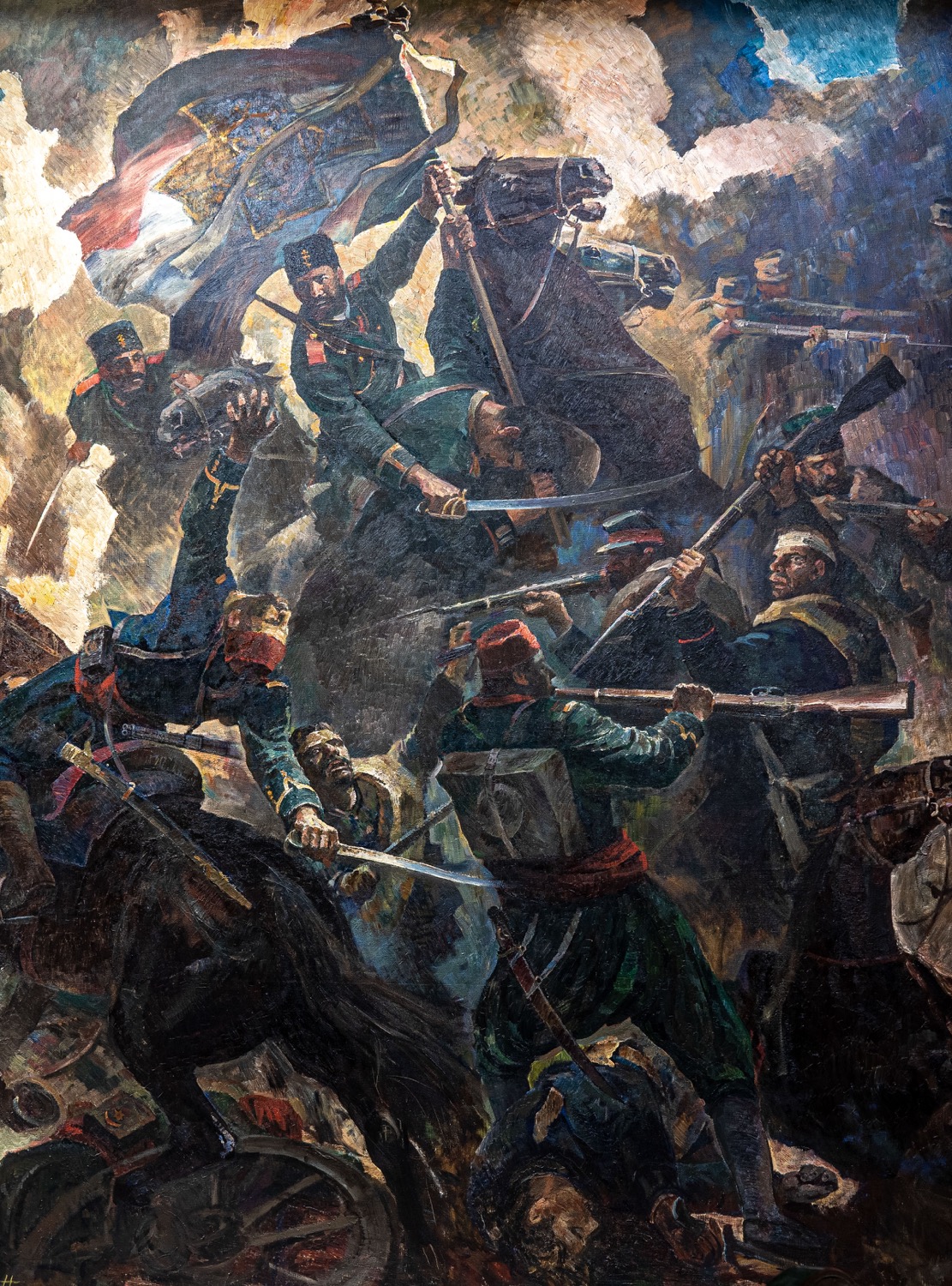
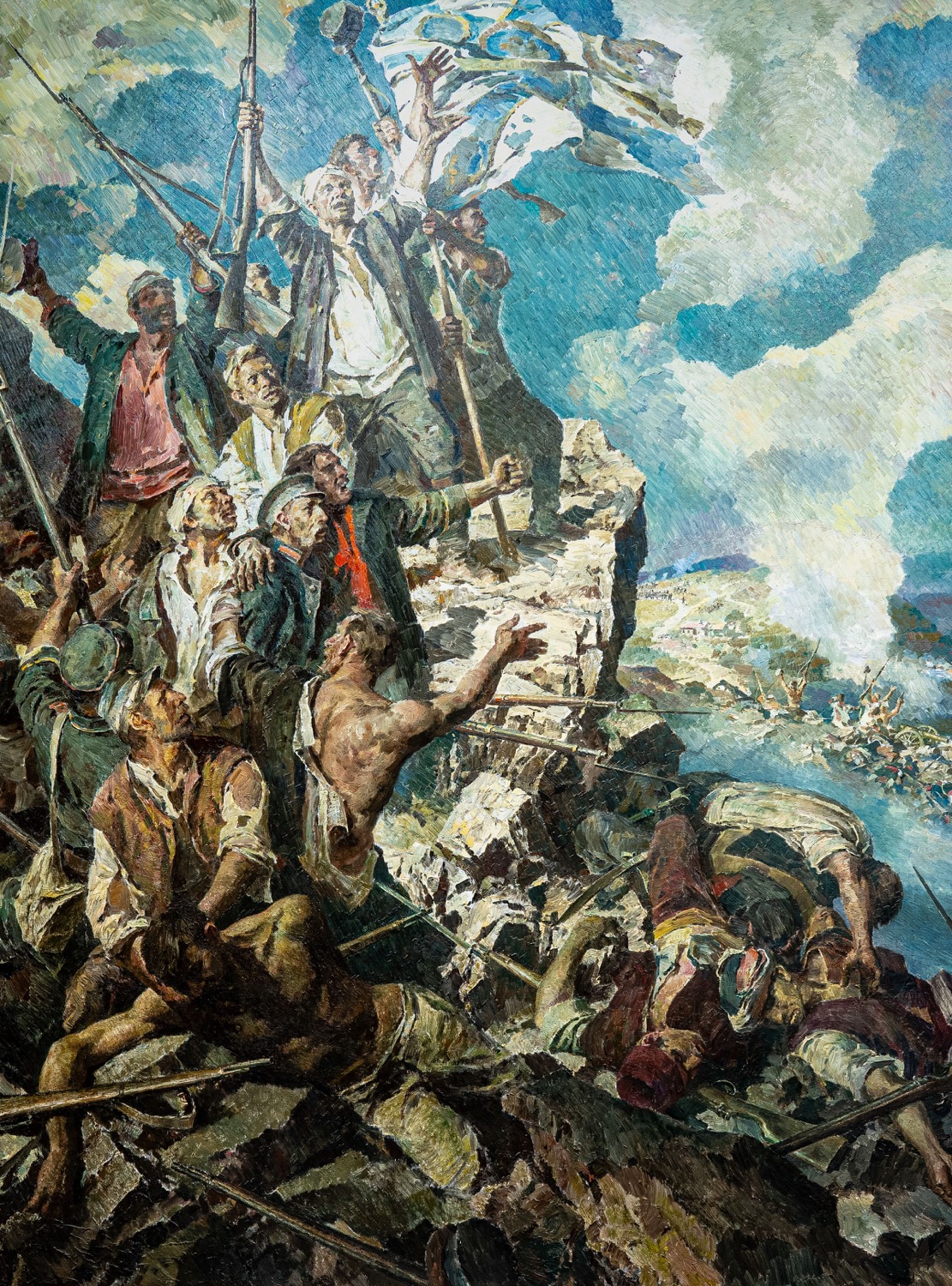
Thousands of Bulgarian volunteers joined the Russian army. They fought their first battle on July 31, 1877, near Stara Zagora. In this heroic clash, the volunteers and Russian soldiers protected the Samara Flag, which became a symbol of honor and bravery. Five soldiers who carried the banner were killed, but the flag of the Bulgarian volunteers was saved.
Artist: N. Ovechkin
The last painting recreates one of the most significant moments of the war—the battle at the mountain pass Shipka. Facing 7,500 Russian soldiers and Bulgarian volunteers was an Ottoman army of 27,000 troops, led by Suleiman Pasha. Between August 21 and 26, 1877, fierce fighting took place. The defenders showed extraordinary courage and self-sacrifice, held their positions, and stopped the Ottoman advance.
The victory at Shipka allowed the Russian command, after two unsuccessful attempts, to prepare the Third Assault for the liberation of Pleven.
Please proceed upstairs to the second hall.
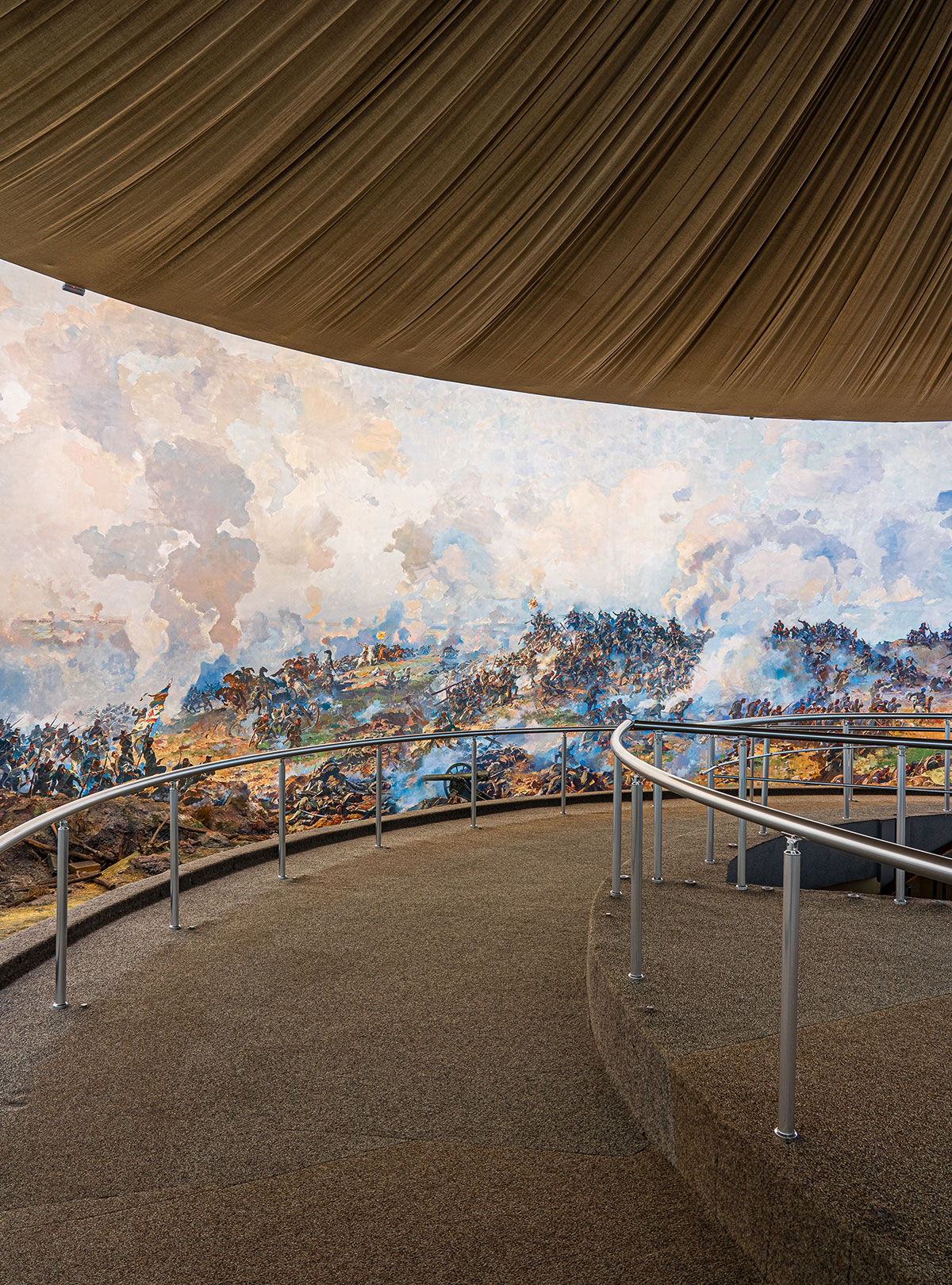
The Panorama Hall presents the Third Assault for the liberation of Pleven, carried out on September 11 and 12, 1877. In this battle, a Romanian army of 35,000 troops joined the Russian forces, under the command of Prince Carol I.
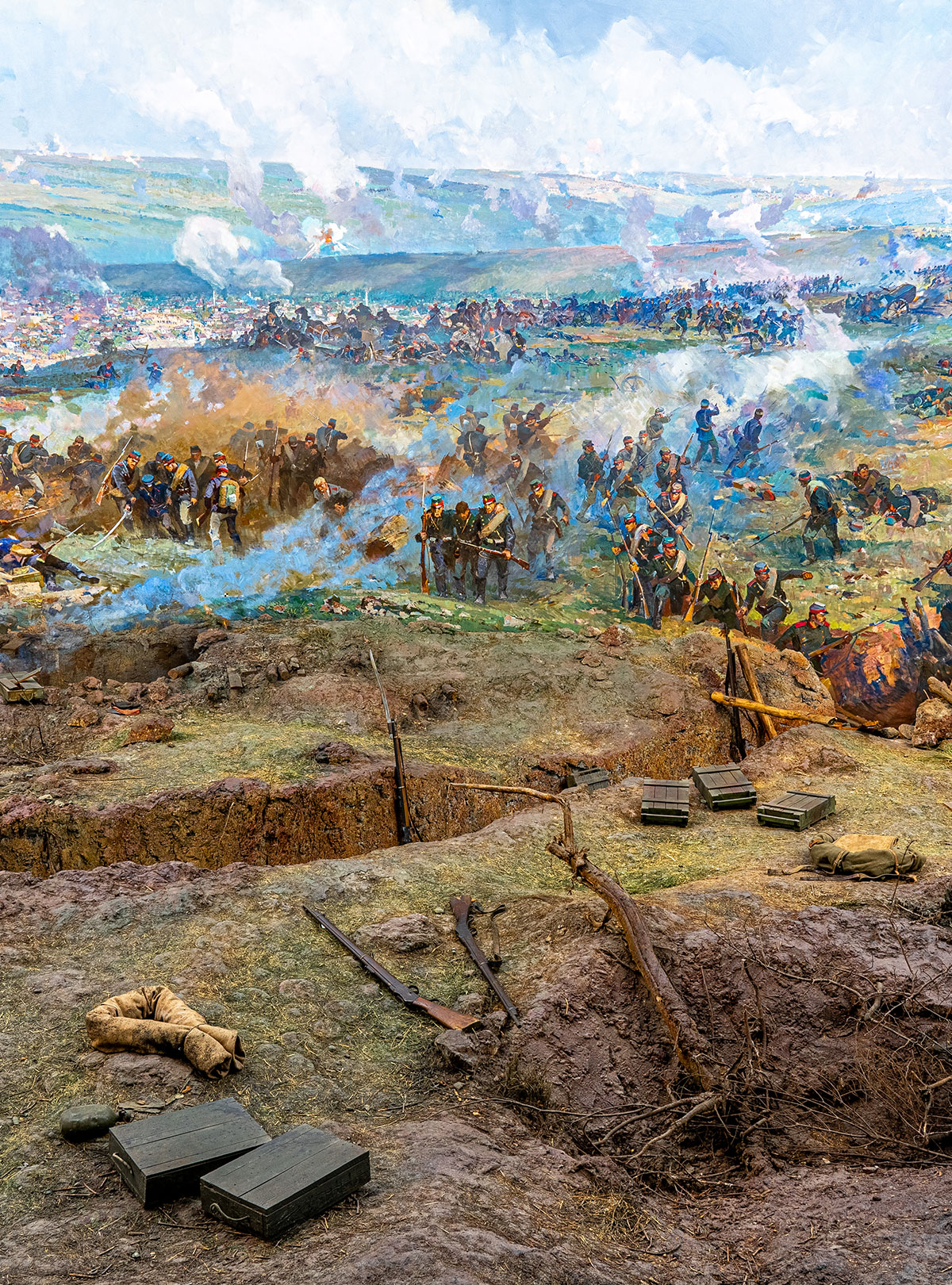
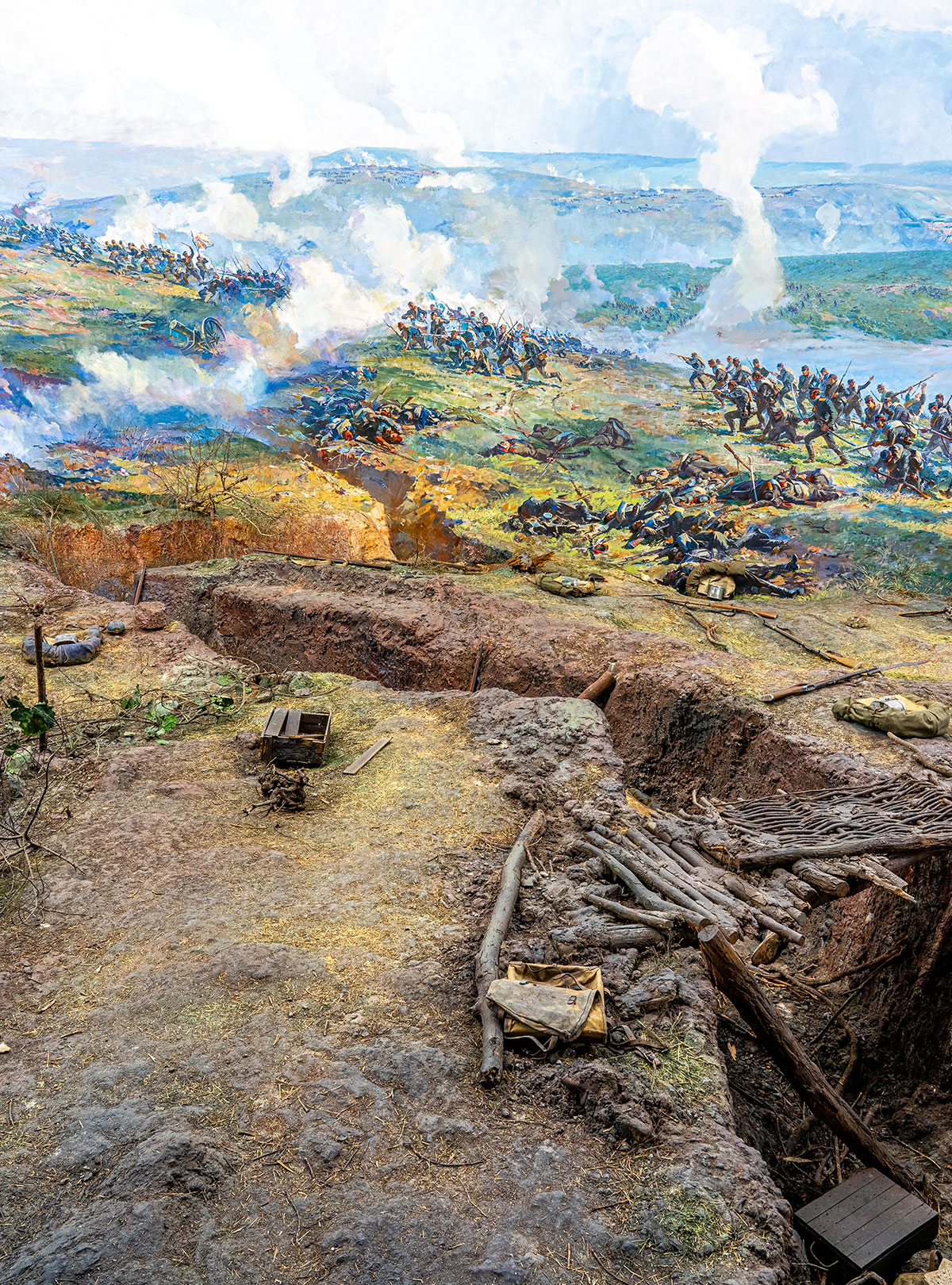
You are standing on the battlefield where the detachment of General Skobelev attacked the Ottoman positions.
Artists: N. Ovechkin A. Chernishov, M. Ananiev, I. Kabanov, V. Esaulov, A. Trotsenko, Yu. Usipenko, V. Shcherbakov, G. Esaulov, V. Lemeshev, V. Tautiev, Hr. Boyadzhiev and D. Donchev
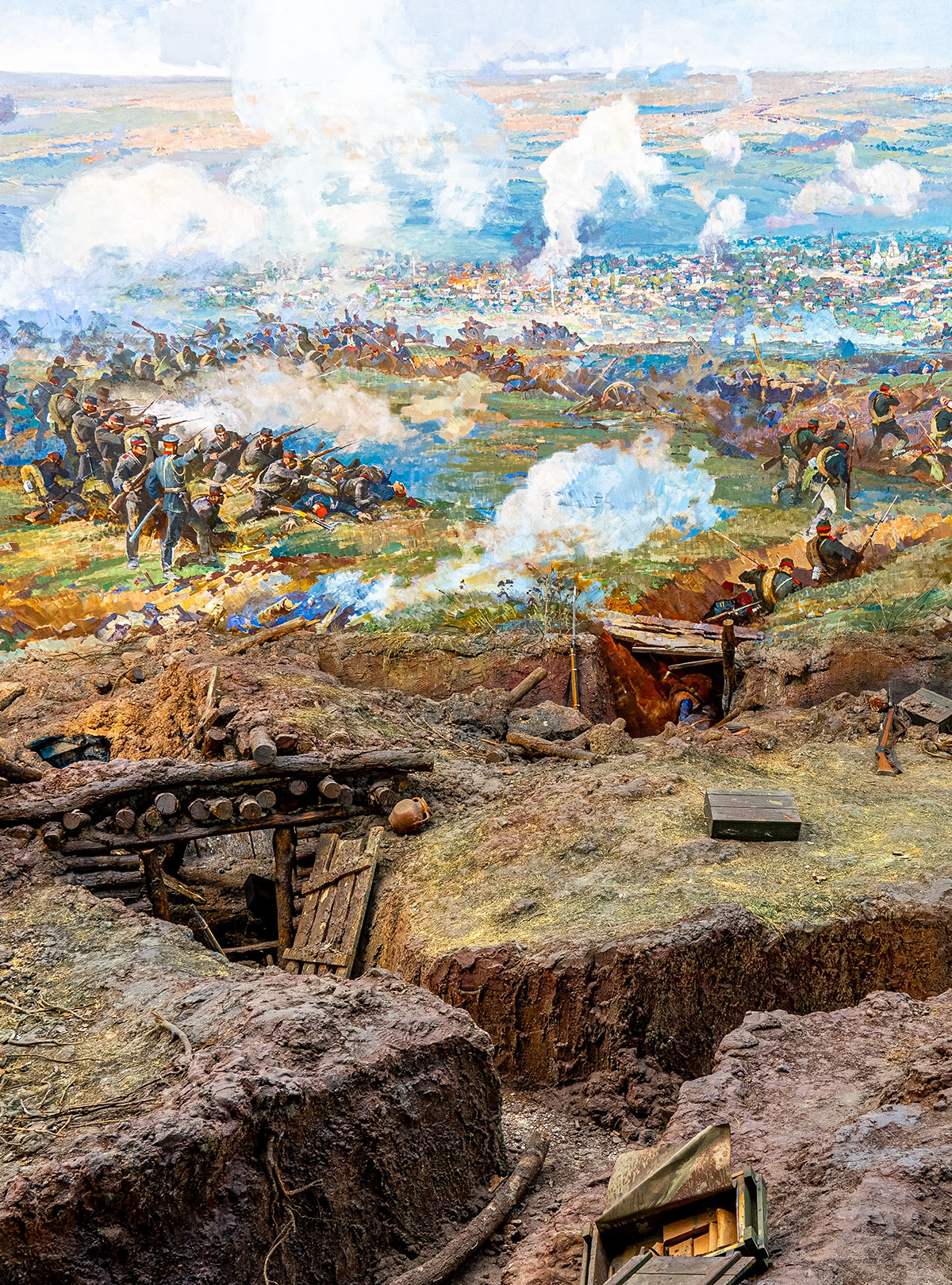
Panoramic art combines a painted canvas, a foreground terrain model, special lighting, and sound effects to create the feeling of being present on the battlefield. The linen canvas is 115 meters long and 15 meters high and was painted by 13 artists in just four months. Beneath it, the terrain model imitates the ground surface and enhances the effect by creating an illusion of depth reaching up to 12 kilometers, placing the viewer at the center of the fighting.
Move closer to explore the scene in detail. Find the city and proceed clockwise, using the photographs in the app as a guide.
At that time, Pleven was an important administrative and commercial center with a population of about 17,000 people. At the beginning of the war, the city had no fortifications and was guarded by only one infantry company.
On July 19, 1877, Osman Pasha and his army occupied Pleven, arriving several hours ahead of the Western Russian detachment. Using the natural elevations around the city, he turned it into an impregnable fortress.
The five-month-long battles, known as the “Pleven Epic,” are among the most significant in terms of duration, number of participants, and casualties, and they played a decisive role in the successful outcome of the war.
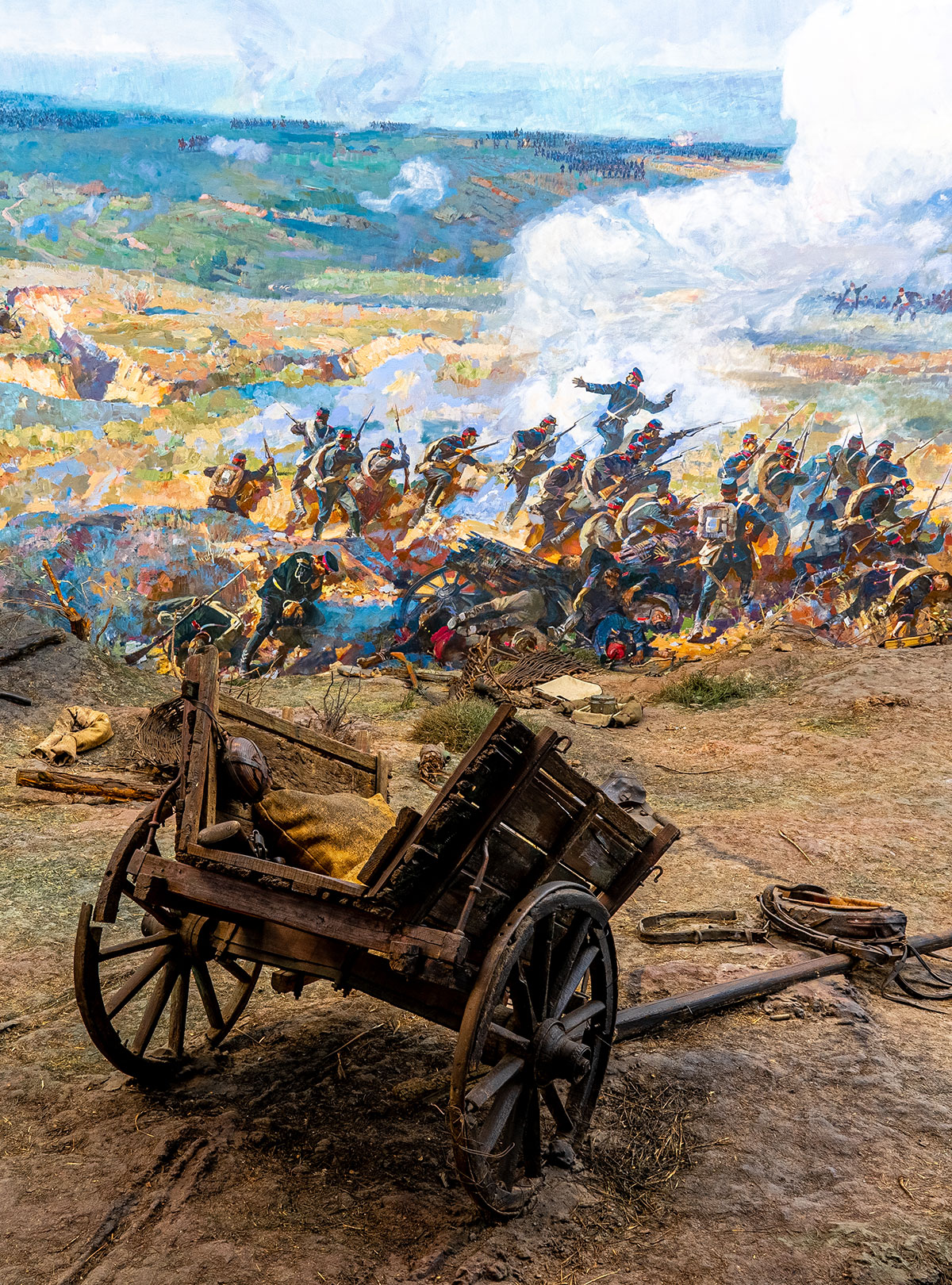
The Third Assault began at 3:00 p.m. on September 11, 1877. The Ottoman army numbered about 35,000 troops, while the allied Russian-Romanian forces counted around 83,000. Fighting took place in three sectors.
In the eastern sector near the village of Grivitsa, heavy fighting took place between the combined Russian-Romanian army and the Ottoman forces. This marked the first participation of the young Romanian army in a major battle. With the support of two Russian regiments, one Ottoman fortification was captured, but no decisive breakthrough toward Pleven was achieved.
In the central sector near the village of Radishevo, the main Russian forces were concentrated. Despite their heroic efforts, the Ottoman defense was not breached, and the fighting ended the same day. The battle was personally observed by Emperor Alexander II and Prince Carol I from a nearby hill.
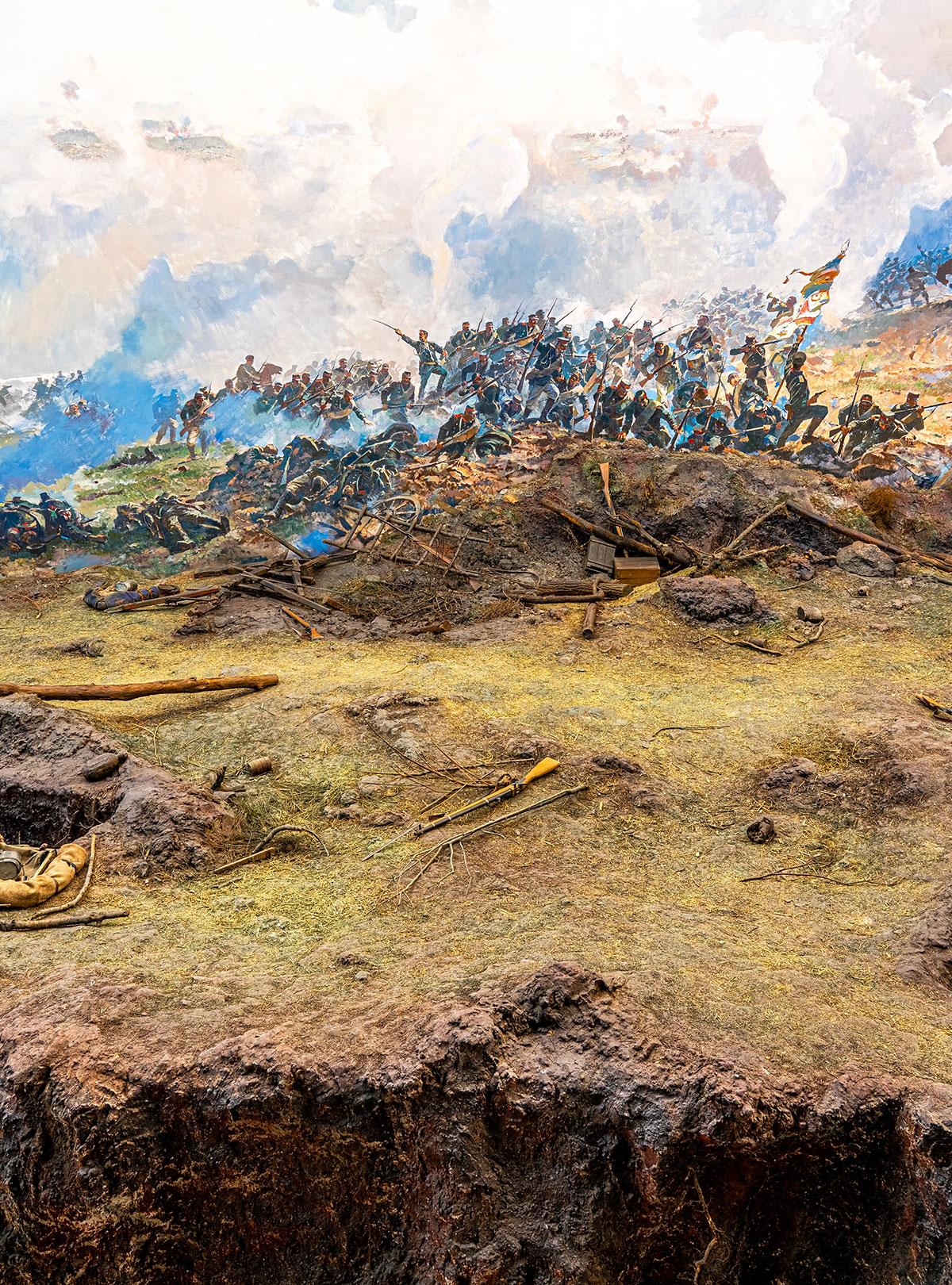
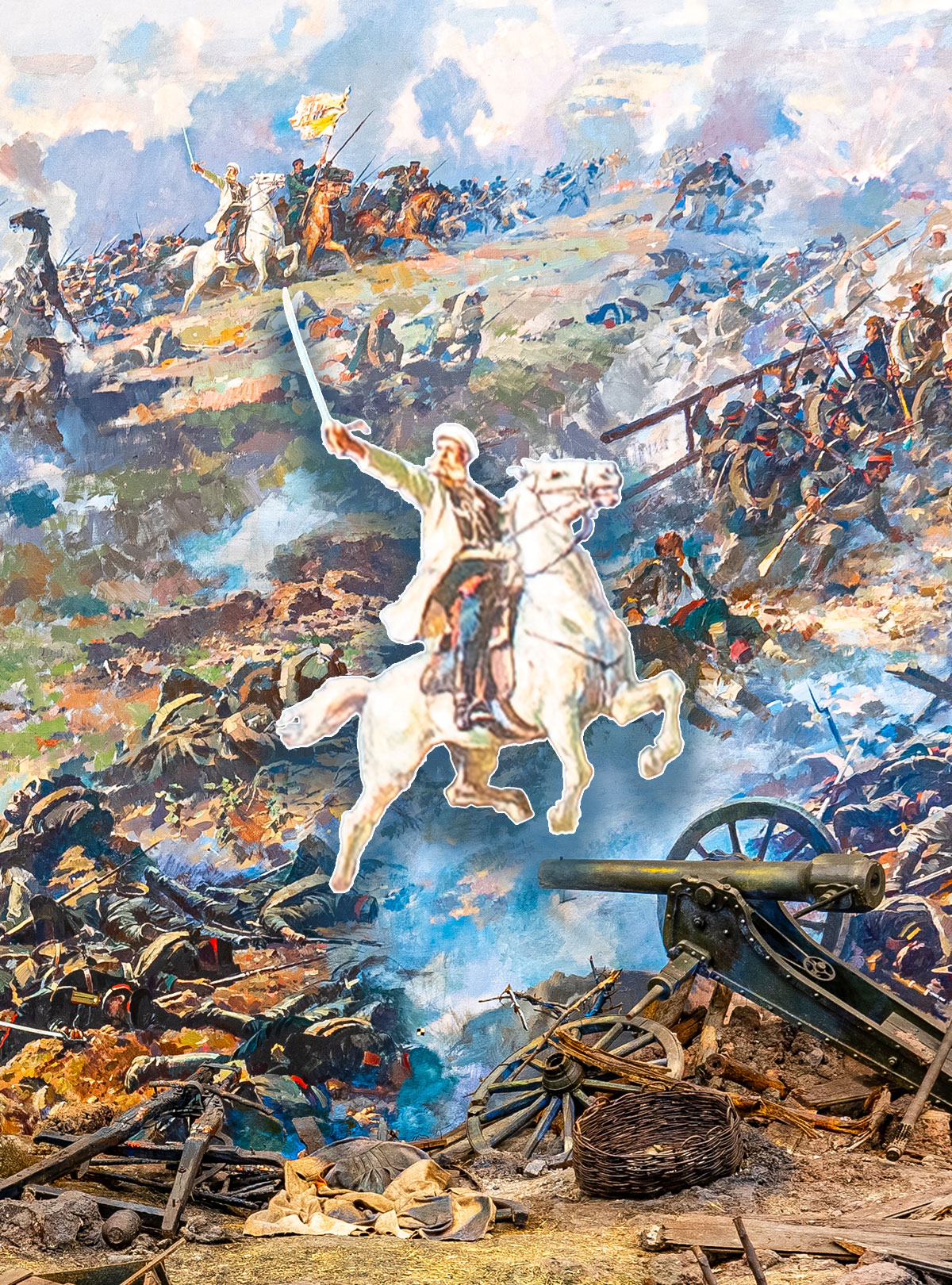
The most successful attack developed in the southern sector, where the Panorama stands today. You are at the center of the battlefield, watching the advance of General Skobelev’s 13,000-strong detachment against the Ottoman fortifications of Kovanlak and Issa Aga. Despite intense fire, the soldiers crossed the open ground at the cost of half their strength. Since then, the valley has been remembered in history as the “Valley of Death.”
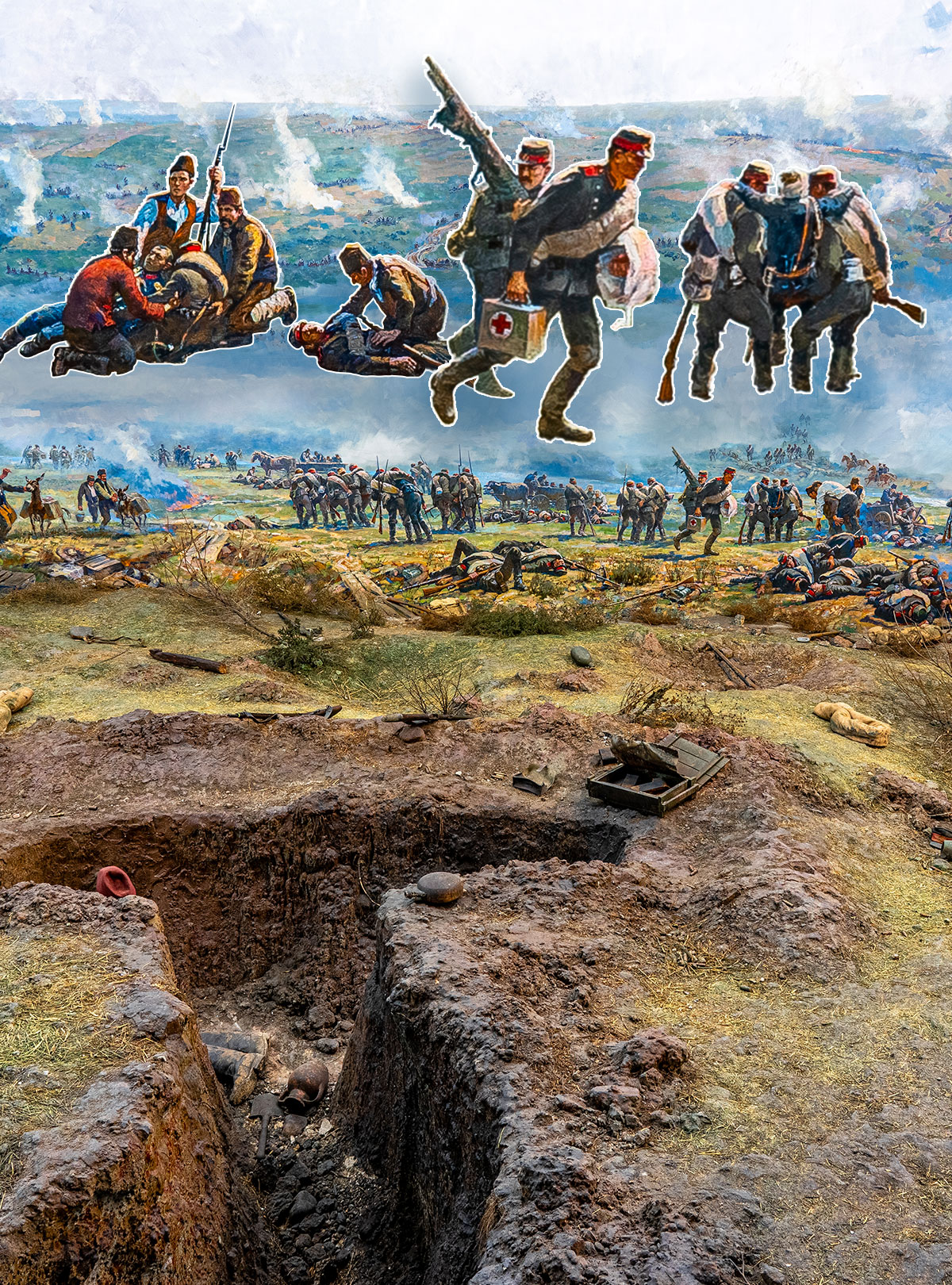
During the war, Russian and Romanian medical personnel played a crucial role. Their efforts saved the lives of thousands of soldiers. Thousands of doctors, medical assistants, and nurses volunteered for the medical corps, and for the first time stretcher-bearers were introduced.
Local Bulgarians also provided voluntary assistance. Using carts and donkeys, they transported the wounded to field hospitals and dressing stations and supplied water, food, and ammunition.
General Mikhail Skobelev, known as the “White General,” is depicted on a white horse, wearing a white uniform, with a saber in hand. Only 34 years old, he was the youngest general in the Russian army and enjoyed great respect among his soldiers.
The painting captures the critical moment when Skobelev personally leads his detachment into hand-to-hand combat, captures the fortifications, and comes within reach of the city. He needed reinforcements to continue the advance, but the command failed to recognize the breakthrough and ordered a retreat. Despite repelling five counterattacks, the detachment was forced to withdraw the following day.
Losses during the Third Assault were enormous—about 13,000 Russian and 3,000 Romanian soldiers and officers killed or wounded.
After yet another setback, the combined Russian-Romanian army changed its tactics and moved to a complete blockade of the city, led by General Totleben. For 45 days, Pleven was completely isolated, while hunger and disease weakened the Ottoman army.
Osman Pasha faced a choice—to surrender or to attempt a breakout toward Sofia. He chose the latter and left Pleven with his troops on December 10, 1877. In the valley of the Vit River, 7 kilometers west of Pleven, the final battle took place, depicted in the next hall.
Please proceed downstairs and follow the arrows.
Artists: N. Ovechkin, A. Chernishov, I. Kabanov, M. Ananiev, V. Esaulov and G. Esaulov
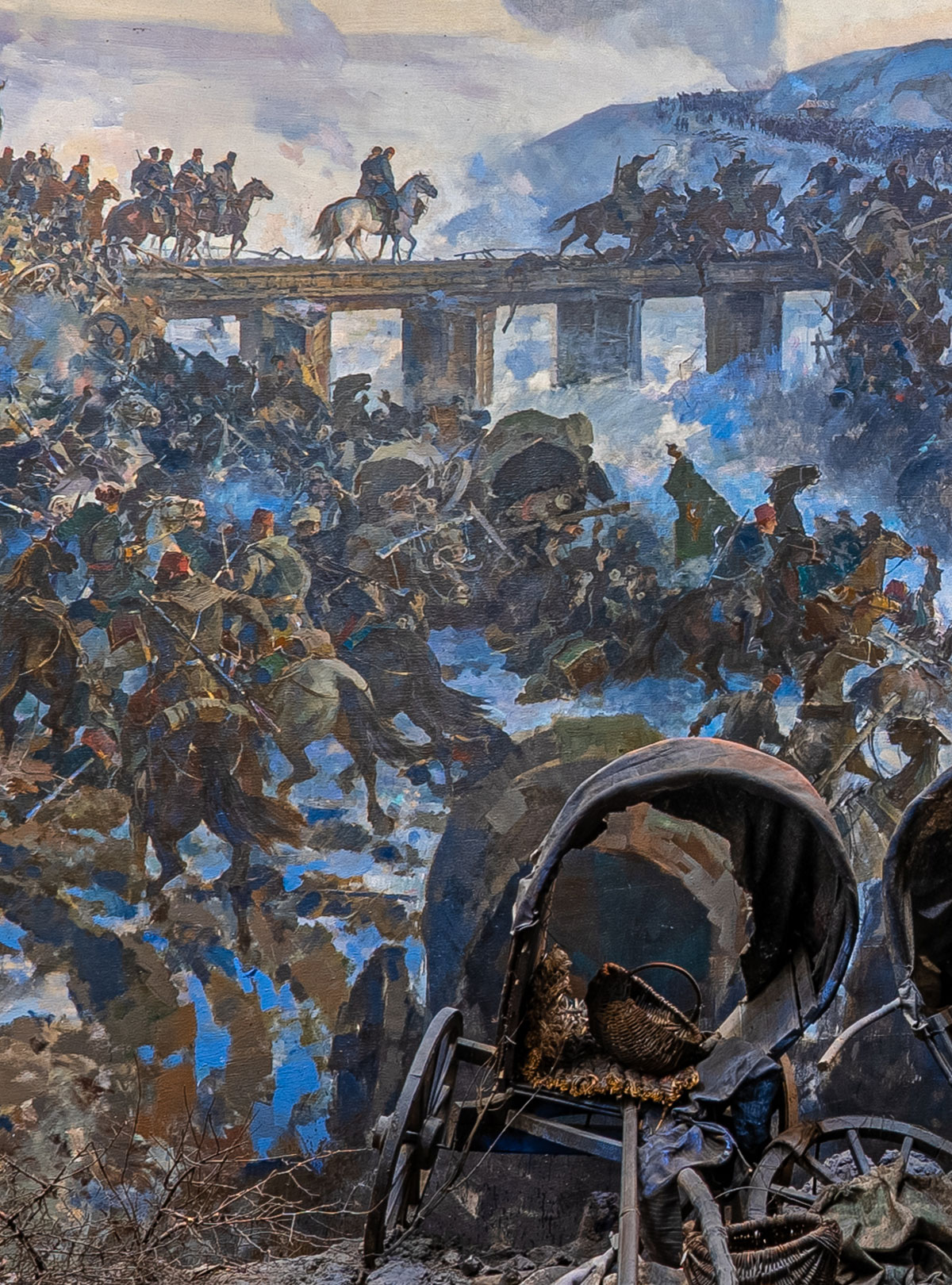
During the night of December 9–10, Osman Pasha left Pleven heading toward Sofia. He divided his army into two divisions, placing the supply train with the wounded and about 300 civilian Turkish families between them. Early in the morning, the first division began crossing the bridge over the Vit River. The Ottomans attacked and captured both defensive lines of the Russian troops commanded by General Ganetsky. By midday, the Russian-Romanian army committed its reserves, pressed the Ottomans from three sides, and inflicted a decisive defeat.
On the bridge, on a white horse, you can see the wounded Osman Pasha. He was taken to the small guardhouse to the right of the bridge. At 2:00 p.m., he raised a white flag and surrendered with an army of 40,000.
What took place inside the military guardhouse, you will see in the final hall.
Artists: N. Ovechkin and A. Chernishov
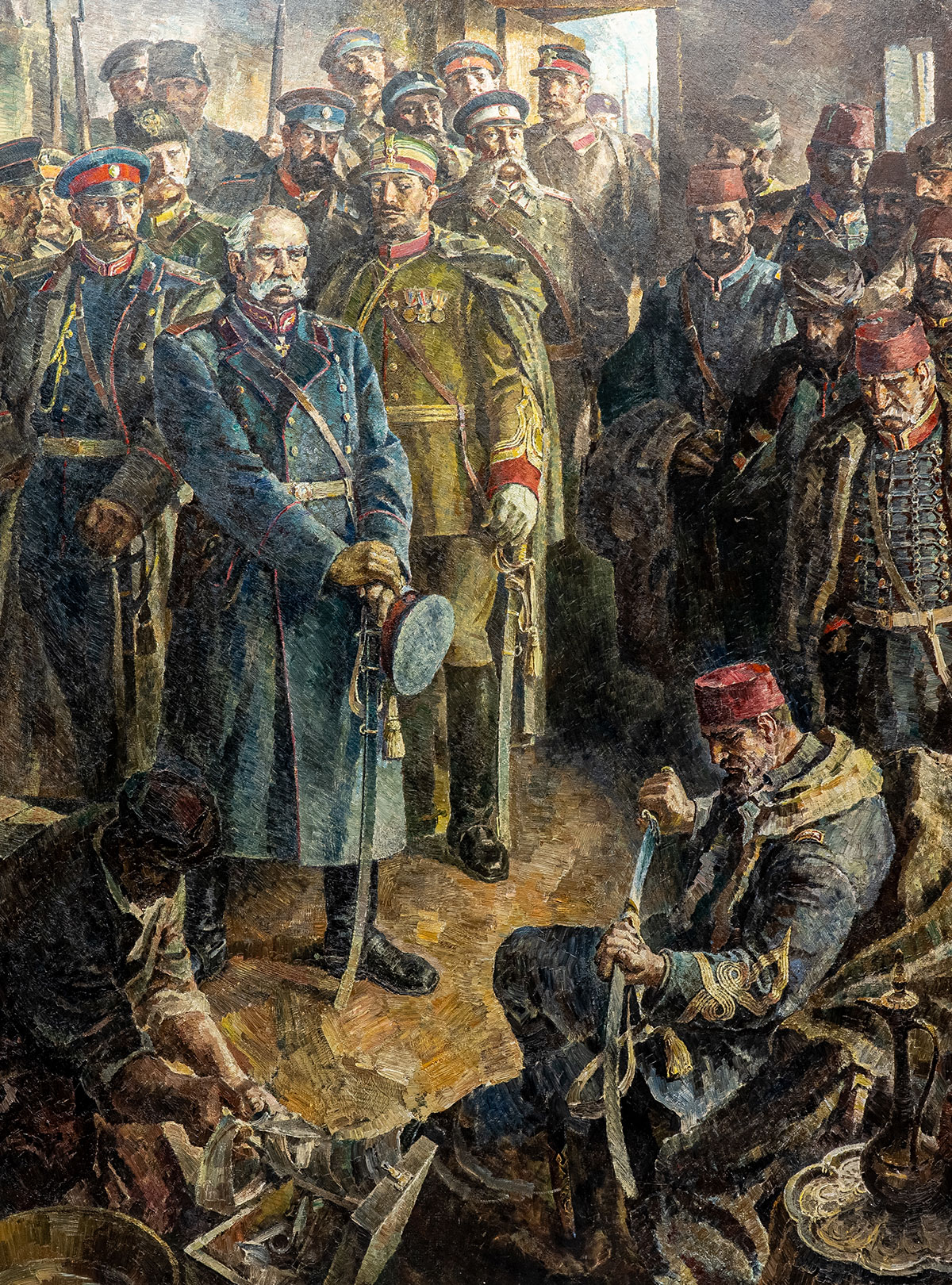
In the guardhouse by the bridge over the Vit River, the wounded pasha declared full and unconditional surrender before Russian, Romanian, and Ottoman officers. Osman Pasha handed General Ganetsky his saber, decorated with diamonds—a reward from the sultan. The following day, as a sign of respect for his military skill, the saber was returned to him by Russian Emperor Alexander II.
After five months of fierce fighting, Pleven was finally liberated. About 31,000 Russian and 4,500 Romanian soldiers and officers were killed or wounded. Casualties on the Ottoman side were approximately 23,000.
Artists: N. Ovechkin and A. Chernishov
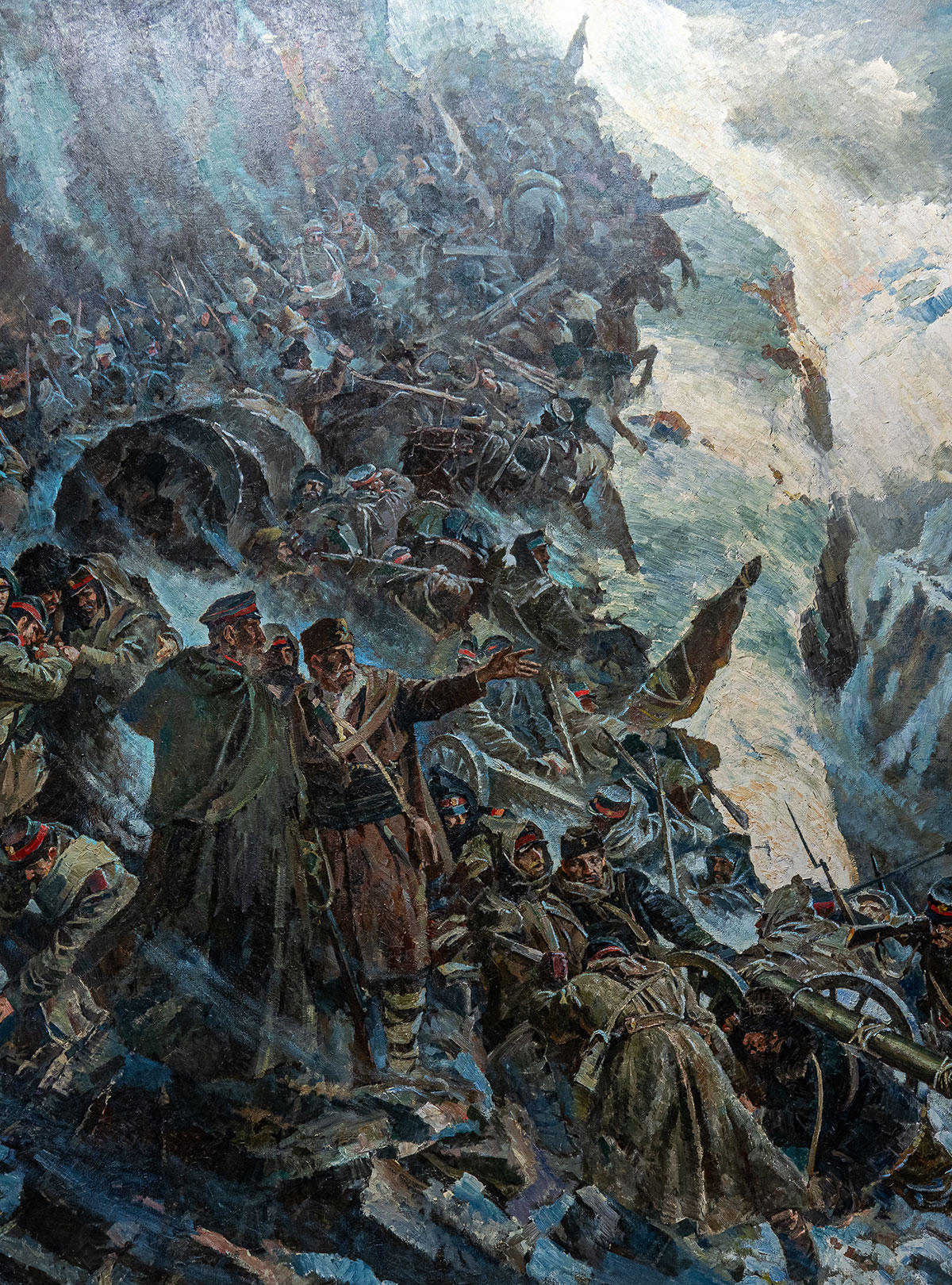
The victory at Pleven marked a turning point in the outcome of the war. The combined Russian-Romanian army of 120,000 continued its advance. The Romanian army fought battles in northwestern Bulgaria, while the Russian army crossed the Balkan Mountains under extremely harsh winter conditions, assisted by Bulgarians serving as guides, interpreters, and scouts.
Within one month, all of southern Bulgaria was liberated, and by the end of January, Russian troops entered Ottoman territory. On January 31, 1878, an armistice was concluded in Edirne, and on March 3, in the outskirts of the Ottoman capital, the Treaty of San Stefano was signed. After five centuries, Bulgaria returned to the political map of Europe as a free state.
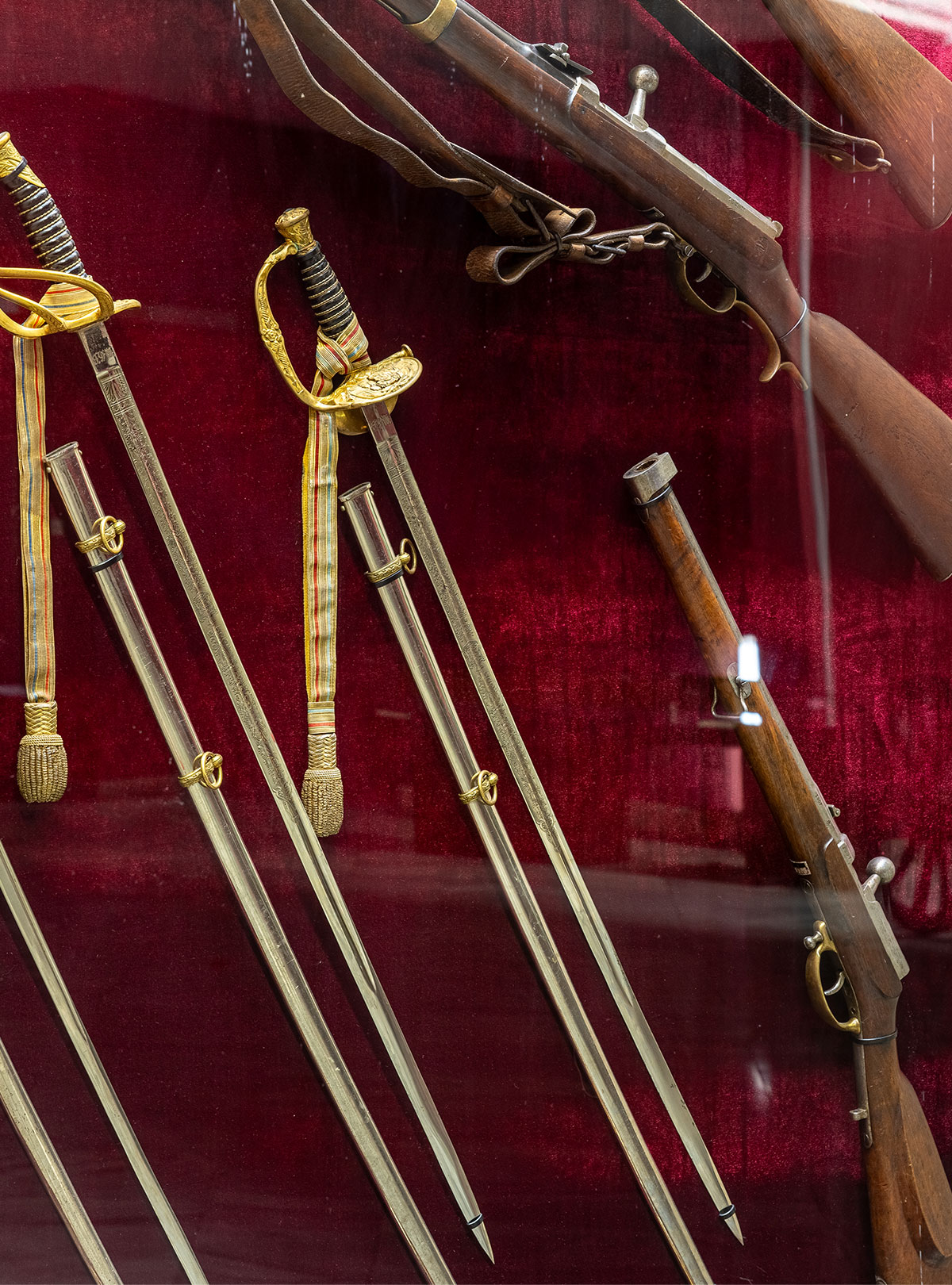
The museum holds the richest collection in Bulgaria of weapons from the Russo-Turkish War of 1877–1878. The hall presents the armaments of the Russian, Romanian, and Ottoman armies, as well as personal items belonging to soldiers, found near Pleven.
This concludes our tour.
We invite you to explore the museum’s temporary exhibitions as well.
Thank you for your visit, and we look forward to welcoming you again!